
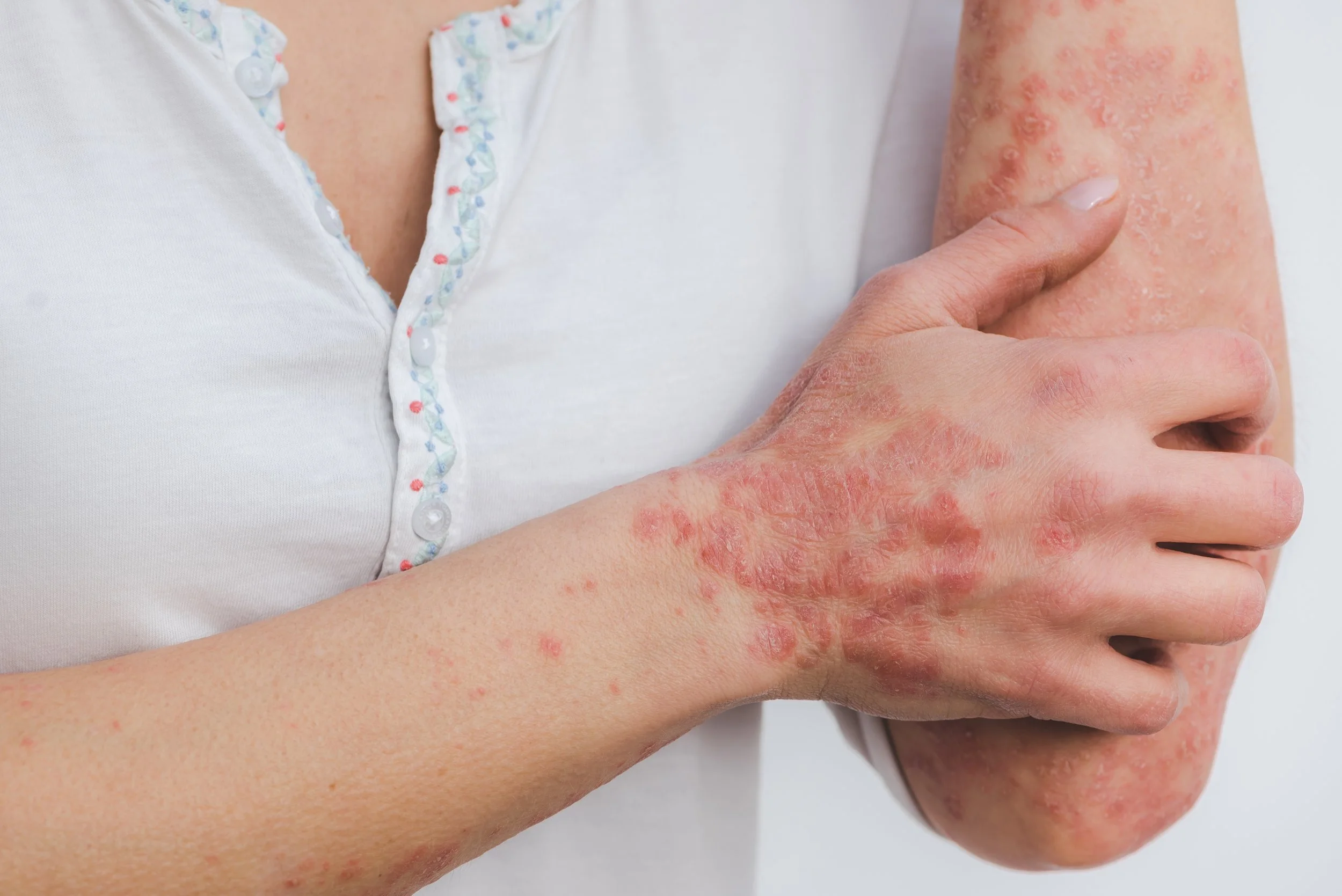
Psoriasis Treatment in Germantown, MD
Psoriasis is more than a skin condition. The itching, soreness, and visible patches can affect your comfort, your sleep, and how you feel in your own skin. The good news is that treatment options have improved dramatically in recent years. At Divergent Dermatology, board certified dermatologist Dr. Qaren Quartey will help you find a plan that controls your symptoms and fits your life.

What is psoriasis?
Psoriasis is a chronic condition in which the immune system speeds up the growth of skin cells, causing them to build up on the surface. It is not contagious, and it can't be spread by touch. Psoriasis often comes and goes in cycles of flares and quieter periods.
Common signs include:
Raised, well-defined patches of skin with a scaly surface
Itching, burning, or soreness
Dry, cracked skin that may bleed
Thick, pitted, or ridged nails
Scaly patches on the scalp that can look like severe dandruff
Stiff or swollen joints (which can signal psoriatic arthritis)
Psoriasis looks different on different skin tones. On lighter skin, patches often look pink or red with silvery-white scale. On darker skin, they may appear purple, violet, dark brown, or gray, and the scale can look thicker. Psoriasis is sometimes missed or mistaken for other conditions, which is why an accurate diagnosis matters. Dr. Quartey is experienced in recognizing psoriasis on all skin tones.
Types of psoriasis we treat
Plaque psoriasis (the most common type)
Scalp psoriasis
Guttate psoriasis (small, drop-shaped spots)
Inverse psoriasis (in skin folds)
Nail psoriasis
Palmoplantar psoriasis (palms and soles)
Psoriasis and your overall health
Psoriasis is linked to other health concerns, including psoriatic arthritis, heart disease, and depression. If you have joint pain, swelling, or morning stiffness along with skin symptoms, let us know. Early treatment of psoriatic arthritis can help protect your joints. We may also recommend working with your primary care doctor or a rheumatologist when appropriate.
How we approach treatment
Treatment depends on how much of your skin is affected, where it is, and how it impacts your daily life. Dr. Quartey may recommend:
Topical treatments: prescription creams, ointments, foams, or solutions to calm inflammation and slow skin cell buildup
Scalp-specific treatments: shampoos and solutions designed for thicker, scalier areas
Light therapy (phototherapy): referral for controlled ultraviolet light treatment
Oral medications: for moderate to severe psoriasis
Biologic medications: targeted injectable treatments that act on specific parts of the immune system, which can be very effective for many patients
Trigger management: identifying factors that can set off flares, such as stress, skin injury, infections, certain medications, smoking, and alcohol
Ongoing monitoring: adjusting your plan over time as your skin and needs change
What to expect at your visit
A conversation. We'll discuss your symptoms, when they began, what makes them better or worse, and your personal and family history.
A skin, scalp, and nail exam. Dr. Quartey will examine your skin to confirm the diagnosis and assess severity. Occasionally a small skin biopsy is needed to rule out other conditions.
A treatment plan. We'll explain your options, including benefits, risks, and what results to expect.
Follow-up. Psoriasis is a long-term condition, so regular visits help keep it under control.
Helpful to bring: a list of your current medications and any treatments you've already tried.
Frequently asked questions
Is psoriasis contagious?
No. You can't catch psoriasis from another person, and you can't give it to anyone else.
Can psoriasis be cured?
There is currently no cure, but many people achieve clear or nearly clear skin with the right treatment. Our goal is to control your symptoms and improve your quality of life.
What triggers psoriasis flares?
Triggers vary from person to person. Common ones include stress, skin injuries, infections, cold dry weather, certain medications, and smoking. We'll help you identify what affects your skin.
Does psoriasis run in families?
Genetics play a role, and many people with psoriasis have a relative with the condition. Having a family history doesn't mean you will definitely develop it.
Do you treat children with psoriasis?
Yes, we see patients of all ages.
Does insurance cover psoriasis treatment?
Psoriasis is a medical condition and visits are typically billed to insurance. Some advanced medications require prior authorization, and our team can help with that process. Please call 240-813-8215 to confirm your coverage.
Are you accepting new patients?
Yes, we're currently accepting new patients.
Take the next step.
You don't have to manage psoriasis alone. Book an appointment or call us at 240-813-8215.
Divergent Dermatology
19785 Crystal Rock Drive, Suite 208
Germantown, MD 20874
Serving Germantown, Gaithersburg, Clarksburg, Montgomery Village, and surrounding communities.